Full-stack assessments: how to evaluate frontend and backend skills in one test
Estimated read time: 5 minutes
Full-stack assessments are pre-employment tests that evaluate a candidate's ability to build working applications across both frontend and backend layers in a single, integrated coding environment — rather than testing each layer in isolation. For recruiters and engineering hiring managers, they answer a specific question: can this candidate ship a functional application end-to-end?
Full-stack roles remain one of the most in-demand — and hardest to screen for — engineering profiles. Traditional coding tests measure isolated skills (a JavaScript question here, a SQL query there) and leave hiring teams guessing whether a candidate can actually stitch a stack together under real conditions.
This article explains what full-stack assessments are, why they're difficult to design well, what sample tasks look like, how HackerEarth approaches them, and answers to the questions hiring teams most commonly ask.
Editorial note: The metadata title on file ("HackerEarth Introduces Full-Stack Assessments At Hire10(1) Conference") does not match this article, which is an evergreen educational guide. The metadata title should be updated to match this H1 before publishing, or a separate press-release article should be commissioned. Flagged for editorial review.
What is fullstack testing?
Full-stack testing, in a hiring context, is the practice of evaluating a candidate's ability to work simultaneously across the frontend (what the user sees and interacts with), the backend (server logic, APIs, business rules), and often the database layer — all within a single assessment.
A well-designed full-stack assessment typically includes:
- A browser-based development environment that mirrors a real IDE
- A pre-configured tech stack (or the ability to install a custom one)
- A task that requires the candidate to build, connect, and run an application end-to-end
- Auto-evaluation for backend logic and structured review artifacts (logs, screenshots, previews) for frontend work
The goal is to observe applied skill — how a candidate structures code, integrates layers, and debugs a running application — rather than to grade isolated snippets. For a broader look at how technical evaluations fit into hiring, see our guide to technical interviews and coding assessments.
Sample full-stack assessment tasks
To make this concrete, here are three example task types that a full-stack assessment can present to candidates. These illustrate the format and depth of what hiring teams typically use in mid-to-late-stage technical screens.
Example 1 — Build a task manager (MERN stack, ~90 minutes). Given a starter repository, the candidate must:
- Build a REST API endpoint (
POST /tasks,GET /tasks,PATCH /tasks/:id) using Node.js and Express. - Persist tasks to a MongoDB collection with fields for title, status, and due date.
- Wire a React component to fetch the task list, add new tasks, and toggle completion status.
- Ensure the running application passes a set of provided end-to-end test cases.
Example 2 — Debug a broken authentication flow (Django + React, ~60 minutes). The candidate receives a running application where login succeeds but session persistence fails on the frontend. They must diagnose the issue across the Django backend, the API contract, and the React state layer, and submit a fix along with a short written explanation of the root cause.
Example 3 — Extend an existing API (any stack, ~45 minutes). Given a working CRUD application, the candidate is asked to add a new resource (e.g., "comments" attached to "posts"), including data model changes, backend routes, and a minimal frontend view. Auto-graded test cases verify the backend; the reviewer inspects the frontend integration.
These formats surface skills that isolated coding puzzles cannot: architectural decisions, cross-layer debugging, and the small integration details that distinguish a shipped feature from a demo.
Is Fullstack still in demand?
Yes. According to the U.S. Bureau of Labor Statistics Occupational Outlook Handbook, employment of software developers, quality assurance analysts, and testers is projected to grow 17% from 2023 to 2033 — much faster than the average for all occupations, with about 140,100 openings projected each year over the decade. Full-stack developers have also appeared on LinkedIn's Emerging Jobs and Jobs on the Rise reports as one of the fastest-growing technical roles.
Demand does not, however, translate to easy hiring. Because full-stack spans multiple technologies, two candidates with the same job title can have vastly different actual skill profiles — which is why structured skill assessments matter more here than in narrower roles.
Can I learn full-stack in 3 months?
Foundational proficiency in a specific stack (for example, MERN or Django + React) is achievable in three to six months of focused study for someone with prior programming experience. Genuine full-stack fluency — the ability to make architectural decisions, debug across layers, and understand trade-offs — typically takes longer and is best measured on the job or through applied assessments.
For recruiters, the practical implication is that resume claims of "full-stack" cover a wide range of actual capability. A structured assessment is often the fastest way to separate a bootcamp graduate from an engineer who has shipped production systems.
Will Fullstack be replaced by AI?
AI coding assistants are changing how full-stack developers work, not eliminating the role. Tools that generate boilerplate, suggest completions, or scaffold components raise the floor of individual productivity but also raise the bar for what employers expect: senior judgment, system design, security awareness, and the ability to review and correct AI-generated code.
For hiring, this shifts the assessment question. Instead of "can this candidate write CRUD from scratch?" the more useful question becomes "can this candidate design, integrate, and validate a working application — with or without AI assistance?" Full-stack assessments that provide a realistic build environment are better positioned to answer that question than multiple-choice tests.
Why full-stack assessments are hard to get right
Most coding assessment tools handle isolated problems well. Full-stack is different because it introduces three specific challenges:
- Environment fidelity. A candidate cannot demonstrate full-stack skill in a text box. They need an IDE, a runtime, and the ability to install dependencies.
- Stack variability. One company's "full-stack" is Django + React; another's is Spring + Angular; another's is Node + Vue. A single question bank rarely fits every team.
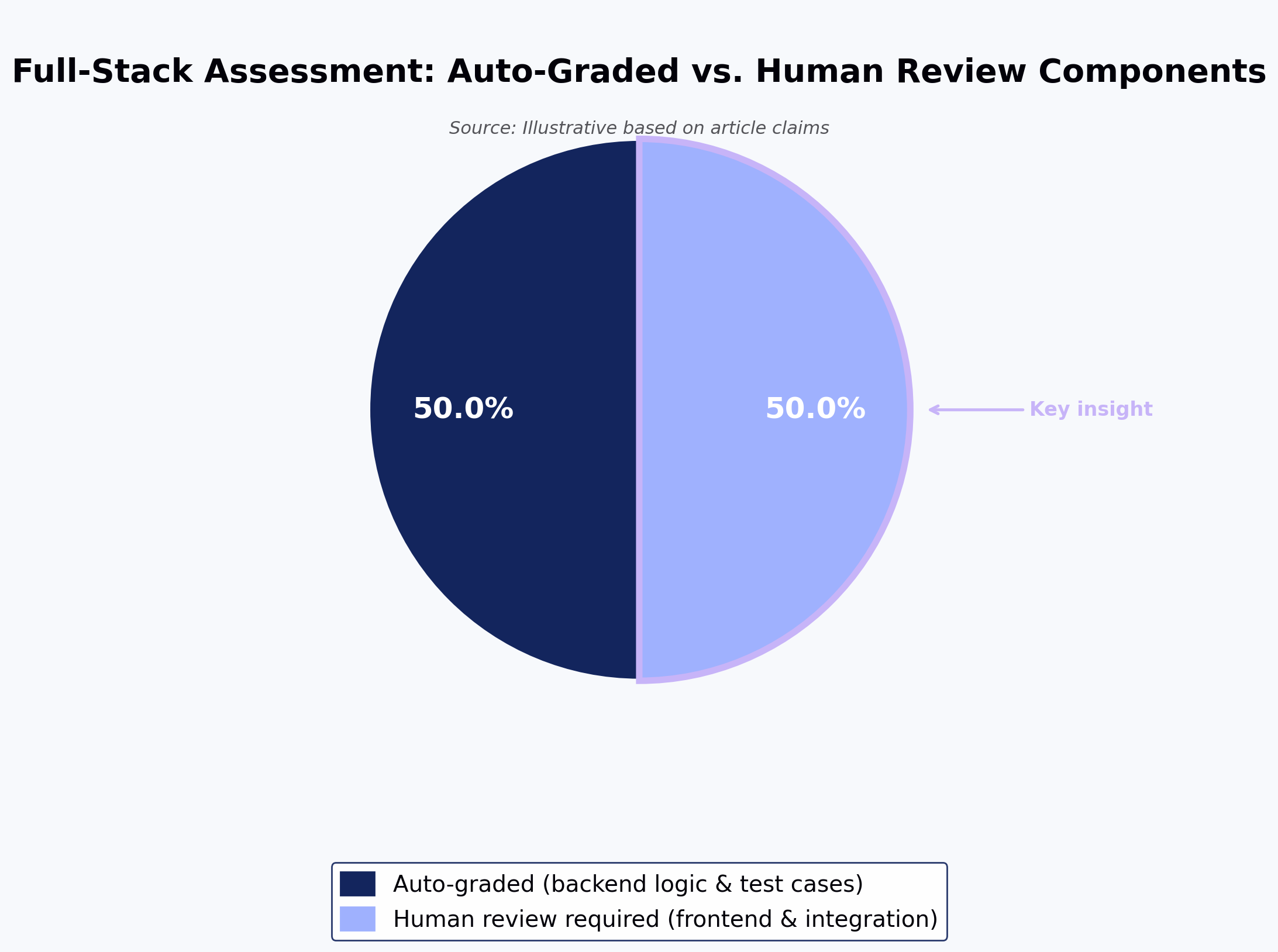
- Evaluation complexity. Backend logic can often be auto-graded against test cases. Frontend and integration work are harder to evaluate automatically and typically require reviewable artifacts — logs, screenshots, or a preview of the running application.
Any team building or buying a full-stack assessment needs to weigh these trade-offs honestly. No tool eliminates the need for a human reviewer at the later stages of a full-stack hire.
How HackerEarth approaches full-stack assessments
HackerEarth Assessments supports full-stack evaluation workflows designed to address the challenges above. In practice, this means recruiters can configure a single test that spans frontend, backend, and integration work — using the same infrastructure that powers HackerEarth's broader technical hiring platform. For teams that already run structured technical hiring, these capabilities fit into existing screening and interview workflows rather than replacing them. More context on assessment design is available in our guide to building effective coding tests.
A few specifics worth naming, rather than a feature list:
The browser-based IDE gives candidates a working environment with terminal access and dependency installation, so they can run and debug applications during the test. The same underlying assessment infrastructure can be used for frontend-only, backend-only, or combined evaluation, which reduces tool sprawl for hiring teams running multiple types of technical screens. Reviewer-facing artifacts — including recordings and application previews — are intended to shorten the time recruiters and hiring managers spend reconstructing what a candidate did.
Note: Specific product capabilities referenced in this section (including underlying editor technology, exact artifact types such as automated screenshots and action logs, the "full-stack assessment" as a named feature, and library counts such as "1,000+ skills" or "40+ languages") should be verified against the current HackerEarth product catalog before publication.
A note on trade-offs
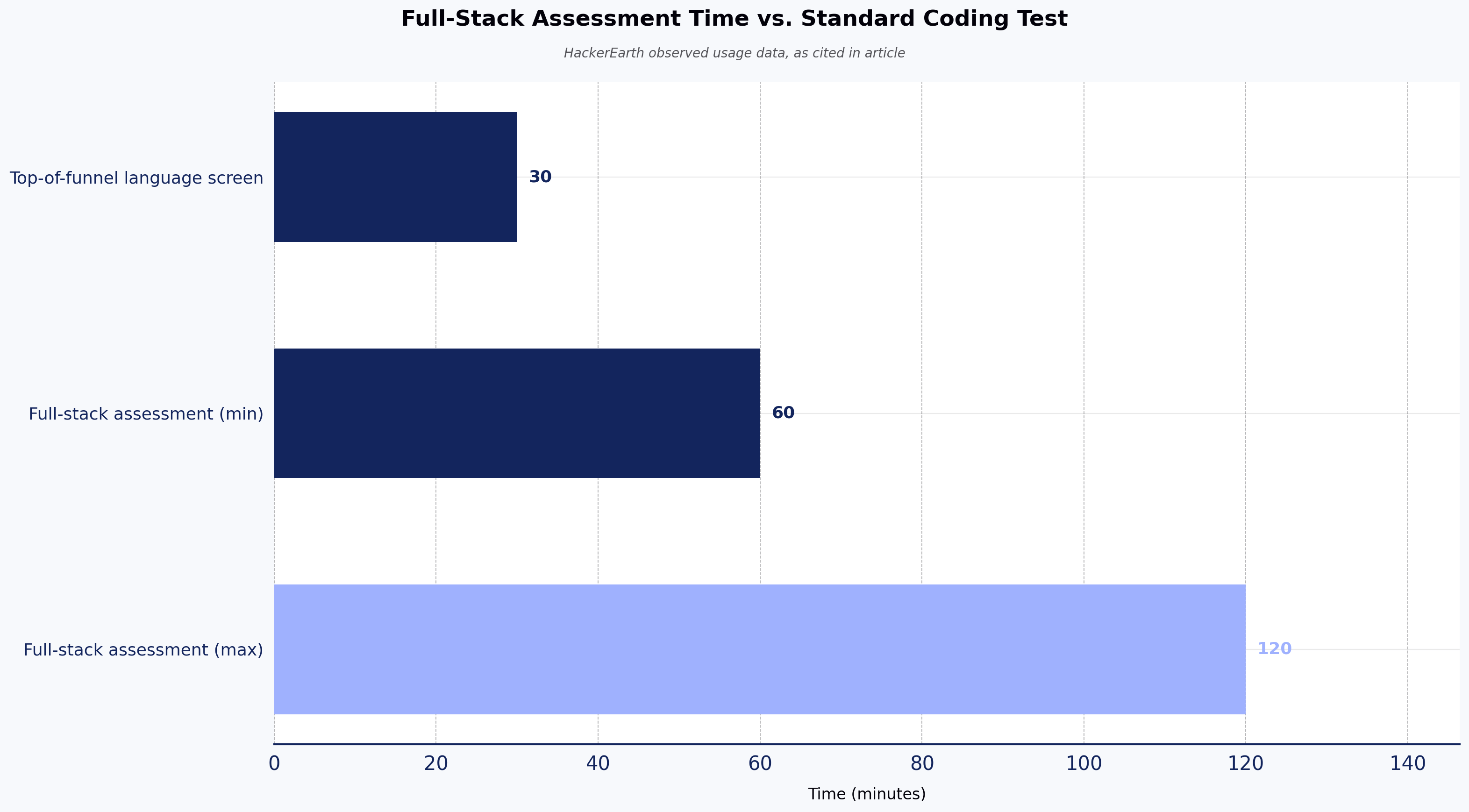
Full-stack assessments take longer to complete than a standard coding round — typically closer to 60–120 minutes for a meaningful task, based on HackerEarth's observed usage — and require more recruiter review time on the frontend portion. Teams should factor that into candidate experience and pipeline design. For high-volume top-of-funnel screening, a shorter language-specific test may be a better fit; full-stack assessments are most valuable at the mid-to-late stages of a technical pipeline.
What to look for in a full-stack assessment tool
Choosing a full-stack assessment tool is less about matching feature checklists and more about matching the realities of your engineering team's stack and pipeline. The most useful evaluation starts with the stacks your team actually ships in production: if your engineers work in Django + React, a tool that only supports Node-based stacks out of the box will create friction, no matter how polished its interface. The ability for candidates to install custom dependencies is closely related — real full-stack work is rarely constrained to a pre-baked template.
From there, the practical questions are about evaluation and workflow. Which parts of the assessment are auto-graded, and which parts require a human reviewer? What artifacts does the reviewer see — logs, a preview of the running application, screenshots, recordings? How is proctoring handled for tasks that run 60 minutes or longer, where basic browser-lock proctoring may not be appropriate? And how does the tool feed results into your ATS and interview workflow, rather than creating a parallel system that recruiters have to reconcile manually?
Working through these questions before demoing tools tends to produce a faster, better-informed decision than starting from feature lists.
FAQ
What is a full-stack assessment, and when is it the wrong tool? It is a pre-employment test that evaluates end-to-end application-building skill in an integrated environment. It is not the right tool for high-volume top-of-funnel screening — the completion time (typically an hour or more) and manual review load make it better suited to mid-to-late pipeline stages, after a shorter language-specific screen has narrowed the field.
How long should a full-stack assessment take? Meaningful full-stack tasks typically require 60–120 minutes. Shorter formats can screen for specific skills but usually cannot evaluate integration and end-to-end build capability.
Can full-stack assessments be auto-graded? Backend logic can generally be auto-evaluated against test cases. Frontend and integration work typically require human review, supported by artifacts such as logs, previews, and screenshots.
Which tech stacks should a full-stack assessment support? At minimum, the stacks your engineering teams actually use in production. Common combinations include Python/Django, Java/Spring, Node.js with React or Angular, and increasingly MERN and MEAN. The ability to install a custom stack matters more than any specific out-of-the-box list.
How is a full-stack assessment different from a regular coding test? A standard coding test usually measures algorithmic ability on isolated problems. A full-stack assessment measures whether a candidate can build, integrate, and run a functional application across multiple layers.
Next step
Schedule a demo of HackerEarth Assessments to see the IDE, question library, and reporting in action against your own role requirements.